Bodhi Leaves - Offerings and Reflections from the Buddhist West

Saturday, January 21, 2012

The Final Post.


After much, much thought, I have decided that I shall be "retiring" this blog.  Simply put, I no longer have the time or resources to make the kinds of detailed posts as I had in the past.  I would love to bring back "Bodhi Leaves" at some point in the distant future but for now I shall be focusing my efforts on a new blog called "A Gentleman Pilgrim." It's dharma-themed travel blog that better suits my current blogging capacity.  If you've enjoyed any of the material on "Bodhi Leaves", then "Bodhi Steps" is certainly worth checking out.

I would thank all of my friends, near and far for all their help and support.  I would especially like to thank all of the readers, whether dedicated regulars or those led here via searches from afar.  At the end, my decision to keep "Bodhi Leaves" up has to do with you.  My writings and reflections shall remain as an offering to you all.

Lotuses for you all,
Buddhas to be,

Rob P.

Monday, June 20, 2011

Dharma Dictionary: Sangha (संघ)

Greetings Dharma Friends! Human beings are social creatures. We love to do activities in groups like watching a basketball game together, eating together (in some cases going to the restroom together), and living together. Group behavior is such a vital part of the human experience that our languages have lots of names for groups of people engaging in similar activities. For example, a group of athletes is called a team, a group of soldiers is called an army, a group of students a class, etc. But is there a name for a group of people whose common interest is spiritual practice? The answer is yes, and name for such a group is called a sangha. To call the concept of a sangha extremely important would be a gross understatement. Before delving into how sangha fits in the Buddha's teachings however, let us first look at the meaning of the word itself. 

The word sangha (pronounced sun-ghuh) comes from the Pali/Sanskrit(1,2) and means "multitude, assemblage, assembly, community, crowd, society, association, congregation, and any number of people living together for a common purpose". In usage, sangha has two distinct but related meanings. In the first sense, sangha refers exclusively to the Buddha's disciples and/or the monastic community of monks and nuns who practice the Buddha's teachings. The second usage refers to anyone, monastic or layperson, that practices the Buddha's teachings or, more broadly, anyone spiritually inclined. The emphasis in this thread will be on the second usage. 

Sangha is such a fundamental and defining characteristic of the Buddha's path to awakening that is considered one of the "Three Jewels". The Three Jewels are 'Buddha', the teacher of the path to enlightenment, 'Dharma', the teachings that lead us to awakening, and finally 'Sangha', the community that practices the Buddha's Dharma. Many might find it odd that a sense of community is so strongly emphasized, particularly in light of the focus on solitary, monastic practice that is found in many of the early texts. The Venerable Ananda, the Buddha's cousin and attendant, touched on this idea in a famous Pali Sutta (3). Here he tells the Buddha, 
"...This is half of the holy life, lord: admirable friendship, admirable companionship,  admirable camaraderie." 
The Buddha's response?
"Don't say that, Ananda.  Don't say that. Admirable friendship, admirable companionship, admirable camaraderie is actually the whole of the holy life. When a monk has admirable people as friends, companions & comrades, he can be expected to develop & pursue the noble eightfold path". 
In our time, we have the expression, "a friend in need is a friend indeed", that is friends who stay with us and never abandon us, no matter how bad the situation may be, are considered the best/truest of friends. This is the purpose and value of a sangha. As a group of like-minded people practicing the Buddha's teachings, we can relate to issues that arise on the path and offer effective help precisely because of our common, spiritual association. A spiritual friend of this sort is known as kalyana mitra in Sanskrit and we can think of a sangha as a group of spiritual friends. Often times these spiritual friends are the Dharma teachers that we learn from. Many times however, they can be our peers or anyone that we happen to learn an insightful lesson from. 

One way we can remind ourselves of the preciousness and importance of the Sangha is to recite/chant/read verses of in praise of it. This has been a traditional practice since the time of the Buddha himself.  As you read these words of devotion (4), remember that you too are part of the Sangha: 
RECOLLECTION OF THE SANGHA
Now let us chant the recollection of the Sangha.
They are the Blessed One's disciples, who have practiced well,
Who have practiced directly,
Who have practiced insightfully,
Those who practice with integrity--
That is the four pairs, the eight kinds of noble beings--
These are the Blessed One's disciples.
Such ones are worthy of gifts, worthy of hospitality, worthy of
offerings,
worthy of respect;
They give occasion for incomparable goodness to arise in the world.

SUPREME PRAISE OF THE SANGHA
Now let us chant the supreme praise of the Sangha
Born of the Dhamma, that Sangha which has practiced well,
The field of the Sangha formed of eight kinds of noble beings,
Guided in body and mind by excellent morality and virtue.
I revere that assembly of noble beings perfected in purity.
The Sangha, which is the supreme, secure refuge of all beings--
As the Third Object of Recollection, I venerate it with bowed head.
I am indeed the Sangha's servant, the Sangha is my Lord and Guide.
The Sangha is sorrow's destroyer and it bestows blessings on me.

***

(1)Pali Text Society's Pali-English Dictionary Online, p. 667
(2)Monier-Williams Sanskrit-English Dictionary, Motilal, 2005 reprint,
p.1129
(4) From the Abhayagiri Monastery Chanting Book, Evening Chanting, p. 13.  The book is freely available in .pdf format: (http://www.abhayagiri.org/main/book/288/)


Sarvamangalam!

Still Standing...

Greetings Dharma Friends.  It has been almost a year since I last posted anything on this blog and the reasons for this are varied.  After a very long break, however, I plan to start posting regularly.  Although I no longer have the time to post as often as I used to, I'm aiming to have at least a couple of posts every week or so.  I also look forward to having insights shared with me.  

I will also be doing some site maintenance, going through old posts and looking for outdated/dead links, etc. 

Thanks for reading!

A lotus for you,
buddha to be

Saturday, July 24, 2010

Dharma Dictionary: Sutra (सूत्र)

It has probably happened to you at some point. You get on the subway and you see someone reading a book. At the next stop someone gets on and they begin to read a book, the same you saw before. While walking in the park, or sitting in a coffee shop, you see people reading the same book. Gradually you hear people talk about this book. You begin to wonder, what is this book about? Was it on Oprah's book of the month or something? Why are so many people reading it? Your friends and family pile on the praises for the book.  Now that your interest is piqued, the next step is to acquire a copy. Maybe you go to the local library, or even try to borrow it from a friend. You could always go to a bookstore (be in person or online) but let's say that none of these options worked. You'd really like to read this book because you see that it's touched the lives of many people, so what do you do? Would you be willing to travel thousands of miles and spend decades in search of this book? Totally insane you might say, is any book worth that kind of effort? Throughout history there have indeed been such books and ones that contain the teachings of the Buddha are known as sutras. 

The word sutra (pronounced 'soo-truh') is derived from the Sanskrit root 'sutr' meaning (1) "to string or put together, to contrive, effect, produce, compose". 'Sutra' itself means, "a thread, cord, string, that which works like a thread which runs through or holds everything together, rule, direction, any work or manual consisting of strings of such rules hanging together like threads". Another (related) definition is, "a carpenter's measuring line". The Pali equivalent is 'sutta' and has the same meanings (2). 'Sutra' is also etymologically related to the English word 'suture', i.e. the thread used to sew a wound closed. 'Sutra' itself is not, by any means, an exclusively Buddhist term. There are Hindu and Jain sutras too. In pop culture, the word is widely known and associated with texts like Patajali's "Yoga Sutras" and more famously the "Kama Sutra" of Vatsyayana (3). 

Sutras are absolutely essential because they are THE record of the Buddha's teachings. If you walk into any bookstore and wander into the "Eastern Religions" section, you'll probably find shelves and shelves of books about what the Buddha taught. All of them ultimately have the sutras as their source material. To read about something is not quite the same as reading something directly. In the same way, being able to read through what the Buddha and his disciples actually taught gives us direct access to the profound teachings that lead to liberation from suffering. 

The collection of sutras is known as the 'Sutra Pitaka" and means, "the basket of teachings". How many sutras are there? A lot. The Sutra Pitaka (in any language) consists of dozens of volumes containing thousands of sutras. This large amount of teachings often compared to a great ocean, not only because its vastness but because of its depth as well. A common expanded version of the   "Taking Refuge" verses contains the follow:
I take refuge in the Dharma,
and I wish that all sentient beings
will delve into the sutras,
their wisdom as deep as the ocean. (4)
The sutras cover every topic from basic meditation instructions and verses on virtue to inconceivable descriptions of the highest and most exalted planes of realization. With so many texts out there, which
ones should we read? Should we even attempt to read all of them? Do we need to? These are common questions which are ones that can only really be answered by looking within. Many people engage in reading the entire Sutra Pitaka as a form of practice (5). Others stick to one sutra and delve very deeply into it. It really all depends on our practice and affinities. There are certainly some sutras which are
more popular than others such as the Heart, Anapanasati, Diamond, Lotus, Shurangama, Avatamsaka, and, Mahasatipatthana to name a few. If you've never read a sutra or would like to take a closer look,
these texts aren't a bad place to start. In studying the sutras, there are a few items that we should keep in
mind. 

First, it is not possible for one sutra to be "better" or "worse" than another. Every (and I mean every!) sutra was composed for a specific audience in a specific context and has a specific message. Because of this, we might find that different sutras say different things about different topics and concepts. This does not, however, mean that one text is right and one is wrong. We can compare this idea to a doctor counseling patients. If we hear this doctor telling his first patient to eat less and then telling his second patient to eat more, we might think the doctor was being contradictory. But what if patient #1 was overweight and patient #2 was underweight? Would we still think the doctor was a quack? 

The goal of every sutra is the same: lead us a step closer to liberation. Because of this, we should read/listen to them with a mind that is as calm, open, and receptive as possible. Sutras are not the sort of thing one would read in a noisy station while waiting for a crowded bus to come. Similarly, we could not fully enjoy or understand a great movie if we watched it half asleep. The right mindset for reading/reciting sutras is important enough to have lead to the tradition of reciting preliminary verses to help settle the mind. You can try it for yourself. Before opening a sutra, slowly and mindfully read its title then recite the following: 
Verse for Opening a Sutra:
The unsurpassed, deep, profound, subtle, wonderful Dharma,
In a hundred thousand million eons, is difficult to encounter;
Now that I've come to receive and hold it, within my sight and hearing,
I vow to fathom the Thus Come One's true and actual meaning. (6)
***
(1) Monier-Williams Sanskrit-English Dictionary, Motilal, 2005 reprint, p. 1241
(2) Pali Text Society's Pali-English Dictionary Online p. 718.
Accessed via the "Digital Dictionaries of South Asia" Project.
(3) At a high school Interfaith presentation, I was asked, in all seriousness, if Buddhism was the "religion with the Kama Sutra" in it.
(4) From the Bodhi Monastery Liturgy:
(5) To the best of my knowledge, there is no complete English translation of the entire Sutra Pitaka although many organizations (like the Buddhist Text Translation Society) are putting much effort into changing that. I believe that a full English translation of the Pali Suttas is available from the Pali Text Society however most of the translations were done in the mid-to-late 1800s. Many of these
translations are dated and in many cases inaccurate but scholars are working hard to revise them. Its only a matter of time before all of the Buddha's teachings are available in the language of Shakespeare, Walt Whitman, and Bob Dylan.
(6) Translation from the Dharma Realm Buddhist Association.

Saturday, July 3, 2010

When It's Time to Get Out of Bed

"Every morning, when we wake up, we have twenty-four brand new hours to live"

Thich Nhat Hanh in Peace is Every Step

Photo: Morning at Bodhi Monastery, NJ; 2006

Sunday, June 13, 2010

Dharma Dictionary: Mālā (माला)

Greetings Dharma Friends! I've finally taken care of business and am happy to announce I'll have the time to start posting regularly again! Now, for the first post in a long while...

Introduction.

Shakespeare’s classic, “Romeo and Juliet”, Juliet says to Romeo:
“What's in a name? that which we call a rose
By any other name would smell as sweet;” (1)
There’s just something about flowers and their beauty that transcends language and culture, as Juliet alludes to. Flowers as are as common to the human experience as they are in nature. Comparisons to flowers, in all their various incarnations, are ubiquitous in art, literature, science, philosophy, and religion. It’s no surprise then, to find flowers as a prominent symbol within the Buddhadharma. One of the most common flower-related words found in the ancient texts is mālā.

Mālā (pronounced maalaa) is a Pali/Sanskrit word meaning “wreath, garland, or chaplet” (2). In popular spiritual usage, it refers to stringed prayer beads. A full discussion of prayer beads covering their origin, usage, and varieties is far beyond the scope of this thread. It is however, worth mentioning that prayer beads are found in many other traditions including Hinduism (where they originated), Islam, Christianity, Sikhism, and the Bahai Faith.

The word ‘mālā’ appears in a famous verse from the Dhammapada (3). The chapter that this verse comes from is, appropriately enough, entitled Pupphavagga (Flower Chapter; puppha = flower) (4).
Yathā'pi puppha rāsimhā
kayirā
mālāgune bahū
Evaṁ jātena maccena
kattabbam kusalam bahum.

“Just as from a heap of flowers,
Many garlands can be made,
So, you, with your mortal life,
Should do many skillful things”.
Dhp Ch. 4, v. 53
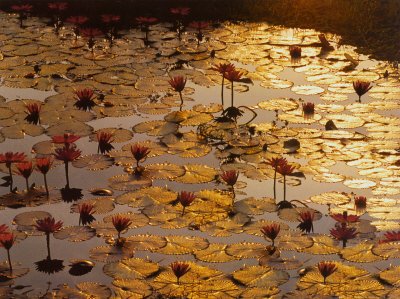
A specific flower that is synonymous with the Dharmic religions is the lotus flower. The Pali word for lotus is paduma (5), while the Sanskrit is the more familiar padma (6). Particularly in India, lotuses have long been regarded as symbols of purity and perseverance. Growing from muddy, opaque pools of water, lotuses rise up and blossom into beautiful flowers. Lotus flowers have the ability to remaining clean, with dust and water being unable to stick to the petals. The scientific explanation for this phenomenon is called “superhydrophocity” but is also more conveniently known as the "Lotus Effect" (7).

One of the earliest references to the lotus occurs in the Sutta 26 of the Majjhima Nikaya (8). In this sutta, called “The Noble Search” (Pali: Ariyapariyesana), the Buddha recounts his spiritual quest as well as the time immediately after his enlightenment. According to this sutta, just after his enlightenment, the Buddha was initially hesitant to teach the Way of Awakening because he wasn’t sure if people could understand it. He says:
"Just then these verses, unspoken in the past, unheard before, occurred to me:
'Enough now with teaching
what
only with difficulty
I reached.
This Dhamma is not easily realized
by those overcome
with aversion & passion.

What is abstruse, subtle,
deep,
hard to see,
going against the flow —
those delighting in passion,
cloaked in the mass of darkness,
won't see.'
At this point, a cosmic being name Sahampati, who comes from the “highest” realm of existence, the Brahma realm, appeared before the Buddha. Sahampati exhorted him to teach, concluding with the lines:
Rise up, hero, victor in battle!
O Teacher, wander without debt in the world.
Teach the Dhamma, O Blessed One:
There will be those who will understand.
The Buddha (thankfully) decided to teach the world the to liberation. He then compared the different stages of living beings to lotuses:
"Then, having understood Brahma's invitation, out of compassion for beings, I surveyed the world with the eye of an Awakened One. As I did so, I saw beings with little dust in their eyes and those with much, those with keen faculties and those with dull, those with good attributes and those with bad, those easy to teach and those hard, some of them seeing disgrace & danger in the other world. Just as in a pond of blue or red or white lotuses, some lotuses — born & growing in the water — might flourish while immersed in the water, without rising up from the water; some might stand at an even level with the water; while some might rise up from the water and stand without being smeared by the water — so too, surveying the world with the eye of an Awakened One, I saw beings with little dust in their eyes [as above]…some of them seeing disgrace & danger in the other world.
Finally, no discussion of flower symbolism in the Buddhadharma would be complete without a mention of the Avataṁaka Sutra (Devanāgari: अवतंसक सूत्र). Avataṁasaka (pronounced ‘uh-vuh-tum-saka’) means ‘wreath’ or ‘ring-shaped adornment’ (9) and is usually translated as “Flower Adornment/Ornament”. This scripture is known as the “King of the Sutras” not only for length (~1600 pages for the complete English translation) but also for the range of practices, ideas, stories, and teachings it conveys. As expected, it is full of flower analogies. One such example occurs in the fifth chapter of the sutra, entitled, “The Flower Bank of the World” (10). Here, the Bodhisattva Samantabhadra (English: Univerally Good or Universal Worthy) is praising the origin of all Buddhas: Bodhisattva Vows. This is not a surprise considering that Samantabhadra is the bodhisattva known as foremost in the practice of Great Vows. Invoking imagery that the Avataṁaka Sutra is so well known for, he says:
That ground is level and utterly pure,
Firmly abiding, indestructible;
It is adorned with jewels everywhere,
With various gemstones interspersed.

The diamond earth is most delightful,
Embellished with jewel rings and nets,
Spread with lotus blossoms in full bloom,
With exquisite raiment covering all.

Enlightening beings’ celestial crowns and jewel necklaces
Are spread all over the ground as decoration;
Sandalwood-scented jewels are strewn about,
All radiating pure, exquisite light.

Jewel flowers flame, producing subtle light;
Flames of light, like clouds, illuminate all.
These flowers, and myriad jewels,
Are strewn over the ground for adornment.

Dense clouds rise and fill the ten directions
With tremendous rays of light that have no end,
Reaching all lands in the ten directions
Expounding the Buddha’s vivifying teaching.

All the Buddha’s vows are in the jewels
Revealing boundless, vast eons;
What the Supreme Knower did in days gone by
Is all seen within these jewels.

Into all the jewels of this ground
Come and enter all the Buddha-fields-
And into each atom of those Buddha-fields
Also enter all lands.

In the Flower Bank world, adorned with wondrous jewels
Enlightening beings travel throughout the ten directions,
Expounding the universal vows of the Great Hero:
This is their power of freedom in enlightenment sites.

The ground arrayed with beautiful precious stones
Radiates pure light replete with all adornments
Filling the cosmos, equal to space;
Buddha’s power naturally manifest like this.

Those who master the vows of universal good,
Those of great knowledge who enter the Buddha’s realm,
Can know, in this ocean of lands,
All such mystic transformations as these.
Sarvamangalam!

***

(1) William Shakespeare, “Romeo and Juliet”, Act 2, Scene 2: http://shakespeare.mit.edu/romeo_juliet/romeo_juliet.2.2.html
From ‘The Complete Works of William Shakespeare’ @ MIT (http://shakespeare.mit.edu/)
(2) Pali Text Society's Pali-English Dictionary Online p. 530. Accessed via the "Digital Dictionaries of South Asia" Project. http://dsal.uchicago.edu/dictionaries
(3) Gil Fronsdal’s translation of “The Dhammapada”, p 14. Shambhala 2005
(4) Pali Text Society's Pali-English Dictionary Online p. 467. Accessed via the "Digital Dictionaries of South Asia" Project. http://dsal.uchicago.edu/dictionaries
(5) Ibid, p. 410
(6) Monier-Williams Sanskrit-English Dictionary, p. 584 Motilal, 2005 reprint,
(7) Wikipedia has a good write-up on the Lotus Effect as well as references to the scientific research papers: http://en.wikipedia.org/wiki/Lotus_effect
(8) Arthur Anthony Macdonell. ‘A Practical Sanskrit Dictionary’. p.29. Oxford University Press, 1929. Accessed via the "Digital Dictionaries of South Asia" Project. http://dsal.uchicago.edu/dictionaries
(9) ‘The Noble Search’ Ariyapariyesana Sutta, from ‘Access to Insight’ http://www.accesstoinsight.org/tipitaka/mn/mn.026.than.html
(10) Thomas Cleary’s full translation of the “Avatamsaka Sutra (Flower Ornament Scripture)”, pp. 205-206, Shambhala 1993.

Wednesday, February 17, 2010

Oprah Talks to Thich Nhat Hanh

Here's a really great one. Oprah recently sat down with Thich Nhat Hanh. The entire thing can be read here.

Saturday, February 6, 2010

A Little Break

Greetings everyone! This is my first post in a very, very long time. In fact, it's my first post of 2010! Things have been quite busy for me the past few months and that's not going to change in the immediate future. (I'll give you a clue, it starts with "th" and ends in "esis"!). Thus, the time I have to post is severely limited but I do hope to find the time to post when I get the chance. Once I'm past "the grind", I look forward to returning with the usual amount of posts. For now, enjoy this essay written by Bhikkhu Bodhi which examines the competing arahant-bodhisattva ideals. Here's an excerpt:
The most archaic Buddhist texts – the Pali Nikāyas and their counterparts from other early schools (preserved in the Chinese Āgamas) – depict the ideal for the Buddhist disciple as the arahant. The Mahāyāna sūtras, composed a few centuries later in a Buddhist Hybrid Sanskrit, depict the ideal for the Mahāyāna follower as the bodhisattva. Now some people argue that because the arahant is the ideal of Early Buddhism, while the bodhisattva is the ideal of later Mahāyāna Buddhism, the Mahāyāna must be a more advanced or highly developed type of Buddhism, a more ultimate teaching compared to the simpler, more basic teaching of the Nikāyas. That is indeed an attitude common among Mahāyānists, which I will call "Mahāyāna elitism." There is an opposing attitude common among conservative advocates of the Nikāyas, an attitude that I will call "Nikāya purism," which rejects all later developments in the history of Buddhist thought as deviation and distortion, a fall away from the "pristine purity" of the ancient teaching. Taking the arahant ideal alone as valid, Nikāya purists reject the bodhisattva ideal, sometimes forcefully.

I am trying to find a point of view that can do justice to both perspectives, that of the Nikāyas and the early Mahāyāna sūtras, a point of view that can accommodate their respective strengths without falling into a soft and easy syncretism, without blotting out conceptual dissonances between them, without abandoning faithfulness to the historical records (yet which also recognizes that these records are by no means crystal clear and are unlikely to be free of bias). This is by no means easy. It’s much simpler to take either a standpoint of "Nikāya purism" or one of "Mahāyāna elitism" and hold to it without flinching. The problem with these two standpoints, however, is that both are obliged to neglect facts that are discomforting to their respective points of view. Although I am ordained as a Theravāda Buddhist monk, in this paper I’m not going to be defending the opinions of any particular school of Buddhism or trying to uphold a sectarian point of view. My first purpose is to draw out from the texts what they say explicitly, and also what they imply, about these two competing ideals of the Buddhist life. At the end, when I draw my conclusions, I will clearly state them as such, and they will be entirely my own. Sometimes I won’t be drawing conclusions but instead raising questions, pointing to problems in the history of Buddhism that I am acutely aware of but unfortunately cannot solve. It is quite possible that what I consider a nuanced and balanced point of view will draw fire from partisan advocates on both sides of the divide.
Also on the topic of Bhante, he will be participating in the Sacred Awakening Series, an interactive seminar involving numerous other teachers from a variety of traditions.

And now, it's back to chopping wood and carrying water.

Sunday, November 15, 2009

In the Laps of those Blessed Ones...

In the laps of those blessed ones dwelling in mountain caves with their minds fixed on the highest light, reposing birds drink fearlessly the water of tears of joy; but our life is spent in the enjoyment of the delights of play in the pleasure groves on shores of reservoirs of mansions fashioned in flights of our imagination.

-Bhartṛhari, Vairāgyaśatakam 15

Thanks to Sean for sharing!

Saturday, October 31, 2009

On the Lake

And fresh nourishment, new blood
I suck from a world so free;
Nature, how gracious and how good,
Her breast she gives to me.
The ripples buoying up our boat
Keep rhythm to the oars,
And mountains up to heaven float
In cloud to meet our course.

Eyes, my eyes why abject now?
Golden dreams, are you returning?
Dream, though gold, away with you:
Life is here and loving too.

Over the ripples the twinkling
Star on hovering star,
Soft mists drink the circled
Towering world afar;
Dawn wind fans the shaded
Inlet with its wing,
And in the water mirrored
The fruit is ripening.

"On the Lake" - Johann Wolfgang von Goethe, from "Selected Poems", edited by Christopher Middleton

Monday, October 12, 2009

Adventures in the Divyavadana - Part II

First, let me apologize for the long delay...

Part I

The first thing which confronted me when opening this book was Andy Rotman's thorough introduction. As with all translation jobs, there's often a fine line to be walked between a more literal (and scholarly) presentation and more free flowing and"looser" one. Rotman manages to deal with this in the form of VERY extensive notes and annotations. For the hardcore Sanskrit students and scholars, many of the notes include the original passages from the Sanskrit. Many of the explanatory notes, however, are invaluable for navigating some of the trickier parts of the text.

And now for the stories themselves. The first volume contains the first 17 stories in the collection. While the content of the stories varies, there are a few unifying themes, the most prominent of which is the law of karma:
Meritorious deeds are to be performed.
Not performing meritorious deeds brings suffering.
Those who perform meritorious deeds
can rejoice in this world and the next.
The Divyavadana is filled with many such simple injunctions to do good and avoid unskillful actions. But in the realm of the Divyavadana even something simple can morph into something far beyond imagination. One example, is story no. 8, "The Story of Supriya" (Supriya-avadāna - सुप्रिय अवदान). This tale begins with a group of robbers and bandits that confront the Buddha and his disciples. In the midst of this, the Buddha (himself a master story teller!) tells the story of a fellow named Supriya. Supriya also found himself confronted with bandits who wished to rob him but makes a deal to secure his release. He promises to find the world's ultimate treasures, thereby satisfying everyone's desires. Thus begins an epic quest involving journeys to far off lands, trysts with divine beings, escapes from fearsome monsters, and travels through time and space.

At this point I should note that I've always loved a good adventure story. While all the other kids were reading Dr. Seuss, I was delving into kiddie versions of The Odyssey and Jason and the Argonauts. Even now, one of my favorite TV shows is the new Doctor Who series.

But the story of Supriya is not simply an adventure story, it's a Buddhist adventure story, with Dharmic themes running throughout. When celestial Kinnara women try to seduce Supriya, he maintains his cool, deeply impressing them:
"The kinnara girls were pleased and said, "It's amazing! You're so young and yet your passion is the dharma. You aren't attached or bound up with desires!" They presented him with many jewels. Drawn in, as they were, by his discourse on the dharma, they gave him a very special jewel as a reward for his noble words".
It wasn't until I finished the Supriya story that I began to realize just why these stories were/are so popular all over the Buddhist world: they work on many, many levels. Profound spiritual teachings are eloquently wrapped in great stories. Some are epic and some are subtle but they all leave a lasting impression on the mind-stream.

One of the shortest but certainly one of the most memorable is story no. 14, "The Story of a Wretched Pig" (Sūkarika-avadāna, सूकरिक अवदान). Here, an inhabitant of a heavenly realm at the end of his life has a vision...of his future rebirth as a pig! As he is about to die, the terrified god struggles to find something that will prevent this unfortunate birth. I won't give away the story but I will say that he resorts to something very simple as a way to try and "escape" his impending destination.

Another tale that left a lasting impression on me is story no. 17, the Story of Māndhātā (Māndhātā-avadāna, मन्धाता अवदान). In this story, the great and powerful king Māndhātā conquers the earth and many heavenly realms with his invincible army. Māndhātā however, doesn't establish control through force or violence, by rather by sheer powerful of his merit. All those who initially oppose him quickly join his ranks, again by the power of Māndhātā 's merit:
Then King Māndhātā arrived at that place and said "Who blocked the army?"
"My lord," they said, "it's the Sadāmatta gods."
"Then the Sadāmatta gods shall become my attendants as well!" the king said. And so the Sadāmatta gods along with the other gods and nāgas began to march in front of him.
Far from being a belligerent tyrant, King Māndhātā actually embodies the idea of the Wheel-Turning King. He also uses his vast, merit-fueled powers to (literally) shower his subjects with the finest of foods, fragrances, jewels, and clothes. Māndhātā's march to the heavens ultimately culminates with his meeting Śhakra, the king of the gods. Śhakra and the gods of the Trāyastriṃśa Heaven give King Māndhātā and his retinue a warm welcome and Śhakra even offers to share half of his seat with Māndhātā. In an single moment however, something happens which instantly leads to Māndhātā's downfall. Most interestingly, his defeat, like his conquests, involves no force. Again, I won't spoil it, but let's say it's the kind of story that powerfully illustrates the opening line of the Dhammapada:
All experience is preceded by mind,
Led by mind,
Made by mind.
Speak or act with a corrupted mind,
And suffering follows
As the wagon wheel follows the hoof of the ox.
-Dhp Ch. 1. v. 1, trans. by Gil Fronsdal
Reading the Divyavadana was a very wonderful and very different experience from so many of the other Buddhist books I've read. It's quickly earned a high spot on my favorite books list and I'm eagerly awaiting Rotman's translation of the second half. I can easily understand why these stories have been around for so long and why they've been so influential. It is my hope that they will continue to enrich, entertain, teach, and inspire practitioners of the Buddha's Dharma for generations to come.

Saturday, October 10, 2009

Heart it is, not a brick or stone

Heart it is, not a brick or stone
Why shouldn't it feel the pain?
Let none tyrannize this heart
Or I shall cry again and again
Neither the temple, nor the mosque
Nor on someone's door or porch
I await on the path where He will tread
Why others should compel me to go?
The illumined grace that lights up the heart
And glows like the midday sun
That Self that annihilates all sights
When then it hides in the mysterious net?
The amorous glance is the deadly dagger
And the arrows of emotions are fatal
Your image may be equally powerful
Why should it appear before you?
The rules of life and bonds of sorrow
In reality are the one manifestation
Before realizing the ultimate truth
How can then one attain liberation?
Love is laden with noble thoughts
Yet what remains is the carnal shame
Trust conscience the still little voice
Why do you want test the rival?
There the pride of modesty resides
Here dwells the social morality
How shall we meet, on which road
Why should he invite me to the abode?
True he is an atheist
Unfaithful and unchaste
Dear to who is faith and heart
Why should he then venture there?
Without the wretched "Ghalib"
Has any activity come to a halt?
What then is the need to cry?
What then is the need to brood?

-Mirza Ghalib (مرزا غالب)

Descending the Mountain


On Friday, Oct. 9th, 2009, John Daido Loori, Roshi, passed away after a long struggle with cancer. Aside from being an accomplished photographer, Daido Roshi will be most remembered for establishing the Mountains and Rivers Order of Zen Buddhism.

Though I've personally not practiced much with the MRO Sangha, Daido Roshi's influence is recent but very profound. It wasn't so long ago that I picked up a copy of his now classic work, "The Eight Gates of Zen: A Program of Zen Training". What struck me most about Daido Roshi's approach was his commitment to a no-nonsense, traditional Zen practice in the midst of working to craft a uniquely Western/American form of the practice. Whereas many 'American Zen' teachers espoused a very flippant, if negligent attitude toward The Precepts, Daido Roshi placed them at the forefront of his teachings and practice (where they belong!). Many American Zen instructors teach meditation as "calm down, feel good" method of practice but Daido Roshi was also keen to emphasize that tranquility and insight cannot and should not be limited to the meditation cushion. His commitment to engagement is evident from the creation of the Zen Environmental Studies Institute as well as the MRO's involvement with the National Buddhist Prison Sangha. His "radical conservative" stance remains an inspiration to me for me own practice and serves as an illuminating example for all those engaged in bring and adapting the Buddhadharma to the West.

This lotus is for you Daido Roshi, a buddha to be.

Tuesday, October 6, 2009

That's the Sound of the Men...

At various points in our lives, we’ve all been nagged at to do some work. When we’re children, our parents nag us about doings tasks like cleaning our rooms, setting the table, laundry, etc. As adults, we get nagged by our co-workers, friends, spouses, and children. All of this complaining implies that there’s a lot of work to be done. This shouldn’t come as a surprise, especially since leading a “busy and hectic life” is the standard for our modern society. If we want anything to be done, we have to do some work; ‘Sine Labore Nihil’ (There’s nothing without work), as the old Latin saying goes (1). We do, however, make a distinction between work we like (e.g. planning for a vacation) and work that don’t like but have to do anyway, like shoveling snow. The term for the latter is “chore”, defined as “A small piece of domestic work, a little job, and a piece of (time-consuming) drudgery” (2). The word ‘chore’ is almost a dirty word but the tasks we usually consider chores are absolutely vital. Try seeing what happens when trash isn’t disposed of (3).

When we hear words like, ‘meditation’, ‘nirvana’, and ‘bliss’ we usually associate them with images of meditating hermits in flowing robes or mystical beings floating in the air with enraptured facial expressions and golden halos. What we don’t normally associate the image of a yogi with are words like ‘mopping’, ‘sweeping’, or ‘polishing’. There is often a disconnection between what we do in our “spiritual lives” (like sitting meditation on a cushion) and the everyday, mundane world that involves activities like washing dishes. In a sutta from the Pali Canon, the Buddha tells us that enlightenment is not to be found out there in the farthest reaches of the cosmos but “it is just within this fathom-long body, with its perception and intellect” (4). If this is true then, ultimately, there is no division between our “worldly” and “spiritual” lives. Think about it: what use is twenty minutes of bliss on the meditation cushion if we go through the rest of the day upset and bothered by what we think are useless chores? It is very easy to set up an artificial separation between the sacred and the mundane but one method to prevent this involves using our “chores” as the object of meditation. Our work becomes our practice.

The idea of work practice is especially emphasized in the Ch’an/Zen tradition of China and Japan. One of the most famous sayings on this subject comes from the famous Tang Dynasty master, Layman Pang (龐居士). When he was asked by his teacher, Shitou (石頭希遷), what he had been doing since they last saw each other Layman Pang said (5):
How miraculous and wondrous,
Hauling water and carrying firewood.
A widely quoted restatement of the above phrase is:
Before enlightenment: chop wood and carry water.
After enlightenment: chop wood and carry water.
In India, the standard monastic model involved wandering for alms but in China, the tradition of manual labor in the monastery gradually became the norm. Work practice became particularly prominent under the influence of the Tang Dynasty Master Baizhang Huaihai (百丈懷海). Master Baizhang (Hyakujo in Japanese) is widely known for his role in the koan, “Baizhang’s Fox” (6). Furry critters aside, Master Baizhang was also renowned for his emphasis on physical/manual labor as part of Ch’an practice. One famous story tells of how Master Baizhang continued to work in the fields into his 80’s. His students however, felt that an 80-something year old Ch’an master shouldn’t be working as strenuously as the young monks so one day they decided to hide his gardening tools. When Baizhang went searching for tools and couldn’t find them, he was unable to work and therefore didn’t. When it came time for the meal, all of the students were waiting for the elderly master to take his food first but instead of doing so, Baizhang said to the assembly, “A day without work is a day without food!” and went back to his room to meditate. The next day Baizhang, without having worked, refused to eat again. After a few days, his students finally got to message and left his working tools in their usual place. When asked of this, he said, “I’m unworthy, how can I allow others to work in my behalf?”(7)

Despite the insight that masters like Layman Pang and Baizhang have, many people still have a hard time (not) separating meditation from plain ‘ol work. Why focus on picking up trash when we could be meditating and entering the deepest meditative absorptions (Pali: jhana), known? A classic story between the very Ch’an-like Ajahn Chah and his student (and later Dharma Heir) Ajahn Sumedho touches on this point. This story, which shall this post, is taken from “Small Boat, Great Mountain: Theravadan Reflections on the Great Natural Perfection”, by Ajahn Amaro (8):

***
“Ajahn Sumedho was a recently arrived monk. He had been there a year or two by this time and was a very serious meditator. He hadn’t been keen to leave the settled life at the main monastery, Wat Nong Pah Pong, but he joined in and there he was—breaking rocks in the sun, pushing barrows of rubble around, and working hard with the rest of the community. After two or three days, he was getting hot, sweaty, and cranky. At the end of the day, after a 12-hour shift, everyone would sit down to meditate and would be reeling. Ajahn Sumedho thought, “This is useless. I’m wasting my time. My meditation has fallen apart completely. This is not helping the holy life at all.”

He carefully explained his concerns to Ajahn Chah: “I’m finding that all the work we are doing is harmful to my meditation. I really think it would be much better for me if I didn’t take part in it. I need to do more sitting and walking meditation, more formal practice. That would be very helpful for me and it’s what I think would be for the best.” Ajahn Chah said, “Okay, Sumedho. Yes, you can do that. But I’d better inform the Sangha so that everyone knows what’s happening.” He could be really wicked in this way.

At the Sangha meeting he said, “I want to make an announcement to everybody. Now, I know that we have all come up here to make this road. And I know that we are all working hard at breaking rocks and carrying gravel. I know this is important work for us to do, but the work of meditation is also very important. Tan (9) Sumedho has asked me if he can practice meditation while we build the road, and I have told him that this is absolutely all right. I do not want any of you to think any critical thoughts of him. It is absolutely all right with me. He can stay alone and meditate, and we will continue building the road.”

Ajahn Chah was out there from dawn until dusk. When he wasn’t working on the road, he was receiving guests and teaching Dharma. So he was really cranking it out. In the meantime,
Ajahn Sumedho stayed alone and meditated. He felt pretty bad on the first day and even worse on the second. By the third day, he couldn’t stand it any longer. He felt tortured and finally left
his solitude. He rejoined the monks, broke rocks, carried gravel, and really gave himself to the work. Ajahn Chah looked at the enthusiastic young monk with a foot-wide grin and asked, “You enjoying the work, Sumedho?”
“Yes, Luang Por.”(9)
“Isn’t it strange that your mind is happier now in the heat and the dust than it was when you were meditating alone?”
“Yes, Luang Por.”

The lesson? Ajahn Sumedho had created a false division about what meditation is and isn’t,
when in fact, there is no division at all. When we give our hearts to whatever we do, to whatever we experience, or to what is happening around us, without personal agendas or preferences taking over, the space of rigpa (10), the space of awareness, is exactly the same”.
***

(1) This phrase also happens to be the motto of my Alma mater, DeWitt Clinton High School :)
(2) Oxford English Dictionary Online, http://www.oed.com
(3) BBC News, “Life Amid the Trash Piles of Naples”:
(4) Rohitassa Sutta, Anguttara Nikaya Section 4, Sutta 45, from ‘Access to Insight’,
(5) Andrew Ferguson, “Zen’s Chinese Heritage”, pp. 94-95, Wisdom Publications, 2000
(6) Hyakujo’s Fox, from “Sacred Texts”:
(7) Andrew Ferguson, “Zen’s Chinese Heritage”, pp. 81-82, Wisdom Publications, 2000
(8) Amaro Bhikkhu, “Small Boat, Great Mountain: Theravadan Reflections on the Great Natural Perfection”, pp. 39-40 Abhayagiri Buddhist Monastery, 2003.
The entire book in .pdf form, along with a number of other Abhayagiri Publications, can be found here
(9) ‘Tan’ and ‘Luong Por’ are Thai terms for ‘venerable’ and ‘venerable father’ respective. The latter is used for addressing elder monastics and is roughly equivalent to the Chinese term ‘Shi Fu’ (師父)
(10) ‘Rigpa’ is a Tibetan term for awareness beyond dualism. It’s a translation of the Sanskrit word ‘vidya’ (विद्य). The concept of rigpa is prominent the in Dzogchen and Mahamudra methods of the Vajrayana tradition.

Seeing the Ultimate

Better than one hundred years lived
Without seeing the ultimate Dharma
Is one day lived
Seeing the ultimate Dharma.

-Dhammapada Ch. 8, v. 115, translated by Gil Fronsdal

Saturday, September 26, 2009

Losing Eternity

How mankind defers from day to day the best it can do, and the most beautiful things it can enjoy, without thinking that every day may be the last one, and that lost time is lost eternity!

-Max Müller

Saturday, September 19, 2009

On a Good Day

"Every morning, when we wake up, we have twenty-four brand new hours to live."

-Thich Nhat Hanh

Thursday, September 17, 2009

The Fifth Mindfulness Training: Nourishment and Healing

Intro.

Aware of the suffering caused by unmindful consumption, I am committed to
cultivating good health, both physical and mental, for myself, my family,
and my society by practicing mindful eating, drinking, and consuming. I
will practice looking deeply into how I consume the Four Kinds of
Nutriments, namely edible foods, sense impressions, volition, and
consciousness. I am determined not to gamble, or to use alcohol, drugs,
or any other products which contain toxins, such as certain websites,
electronic games, TV programs, films, magazines, books, and
conversations. I will practice coming back to the present moment to be
in touch with the refreshing, healing and nourishing elements in me and
around me, not letting regrets and sorrow drag me back into the past nor
letting anxieties, fear, or craving pull me out of the present moment. I
am determined not to try to cover up loneliness, anxiety, or other
suffering by losing myself in consumption. I will contemplate interbeing
and consume in a way that preserves peace, joy, and well-being in my body
and consciousness, and in the collective body and consciousness of my
family, my society and the Earth.

Saturday, September 12, 2009

A What in the Where?!

I recently came across two interesting stories about Thomas Dyer, a US Army National Guardsman from Tennessee who also serves as a Buddhist chaplain. Yes, Buddhist chaplain. Dyer's spiritual journey from Bible Belt Baptist to Buddhism is fascinating in itself but his story also raises very interesting points regarding Buddhists in the military, especially the US military. The first story looks at Dyer's background. The second story is an interview he gave to NPR recently. Both are thought provoking, to say the least. Here's an excerpt from the interview:
MARTIN (NPR): Now, your story is interesting, I think, for many reasons. Not only are you the military's first Buddhist chaplain; before that, you were a Southern Baptist minister, which turns out to be important to your current post - we'll get to that. Can you just tell us what drew you to Buddhism, recognizing that, of course, it's complicated and a complicated journey for anyone, but can you help us understand what drew you to the faith?

Mr. DYER: I think the journey begins with meditation. The idea of meditation is not to talk or interact with words but to just sit with God or Christ. In my pastorate as a Southern Baptist pastor, in my office, I would sit and meditate in this manner. As I began to interact with Zen Buddhism itself, pretty much like a homecoming, so to speak.

MARTIN (NPR): You know, it's a remarkable coming together of all your various lives, if I can put it that way. I mean, your family, your wife and your children have not embraced the same path as you. How is that working, if you don't mind my asking?

Mr. DYER: My wife and family are very committed Christians, and I support that. But you can imagine with great compassion how they would feel. But I've decided that this Buddhism is an individual path. So I support my family, my wife's Christian faith, and I help support raising our children in the Christian faith, as well.